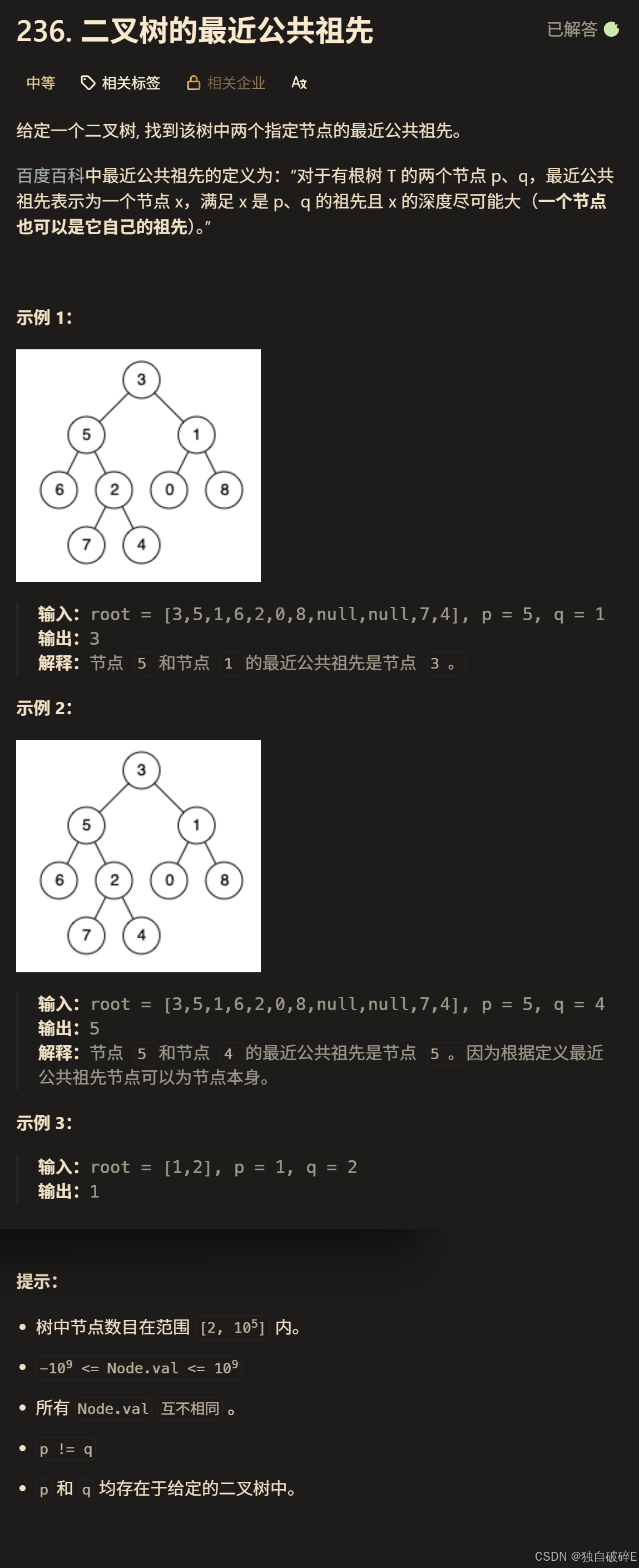
核心思路
从根节点开始,向左右子树递归搜索目标节点,然后根据左右子树的返回结果判断最近公共祖先的位置。
1.递归终止条件
1
2
3
|
if (root == null || root == p || root == q) {
    return root;
}
|
如果搜索到了空节点,说明这条路径上没有找到目标节点;
如果当前节点就是我们要找的节点之一,直接返回。
2.向左右子树递归搜索
1
2
|
TreeNode l = lowestCommonAncestor(root.left, p, q);
TreeNode r = lowestCommonAncestor(root.right, p, q);
|
分别在左子树和右子树中搜索 p 和 q。
3.根据搜索结果判断
(1) p 和 q 分别在当前节点的左右两侧,那么当前节点 root 就是它们的最近公共祖先。
1
2
3
|
if (l != null && r != null) {
    return root;
}
|
(2)左右子树都返回 null,说明当前子树中既没有 p 也没有 q。
1
2
3
|
if (l == null && r == null) {
    return null;
}
|
(3)当 l 和 r 一个为空、一个不为空时,返回非空的那个结果。
1
|
return l != null ? l : r;
|
代码实现
 1
 2
 3
 4
 5
 6
 7
 8
 9
10
11
12
13
14
15
16
17
18
19
20
21
22
23
|
public static TreeNode lowestCommonAncestor(TreeNode root, TreeNode p, TreeNode q) {
    if (root == null || root == p || root == q) {
        // 遇到空,或者p,或者q,直接返回
        return root;
    }

    TreeNode l = lowestCommonAncestor(root.left, p, q);
    TreeNode r = lowestCommonAncestor(root.right, p, q);

    if (l != null && r != null) {
        // 左树也搜到,右树也搜到,返回root
        return root;
    }

    if (l == null && r == null) {
        // 都没搜到返回空
        return null;
    }

    // l和r一个为空,一个不为空
    // 返回不空的那个
    return l != null ? l : r;
}
|
如果觉得有帮助,欢迎点赞、关注、转发~